
m e m o r i a #3
Book presentations:
La couverture immatérielle & (Faire) Face au nucléaire
In situ conversation:
with artist Cécile Massart and Danielle Leenaerts, art historian
Thursday 26 November 2026 – Brussels 1050
7.00 – 8.30 pm
Booking essential: memoria.bibliotheque@gmail.com

Nuclear matters: the third moment of m e m o r i a, with two books that bear witness to a pervasive situation that we strive to repress. La couverture immatérielle (fr-en-jap) is Cécile Massart’s artist’s book on the aftermath of Fukushima. (Faire) Face au nucléaire (fr-en) was edited by Danielle Leenaerts, art historian, brings together contributions from nine artists. If photography is the medium that reveals the “atomic age”, through its exhibitions, books and thinking subjects, such images are placed under a double horizon: spatial, with the burial of waste – oblivion or amnesia – and temporal, with the immeasurable duration of its radioactivity, co-produced by the extraction of raw materials and their transformation through advanced technologies.
Image © Cécile Massart · Screen-printing on a photograph, detail · Soulaines-Dhuys, France
. . . . . . . . . . . . . . . . . . . . . . . . . . . . . . . . . . . . . . . . . . . . . . . . . . . . . . . . . . . . . . . . . . . . . . . . . . . . . . . . . . . . . . . . . . . . . .
Book lauch: Tsunami Trees
In situ conversation with photographer Hatakeyama Naoya
and the publisher Light Motiv
Tuesday 6 October 2026
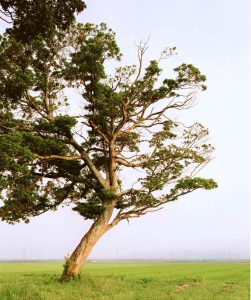
Tsunami Trees is a book about survival: the survival of trees after the 2011 tsunami in the prefectures of Iwate, Miyagi and Fukushima in Japan.
Hatakeyama Naoya considers that the sites he photographs “before, during and after” are not nostalgic mementos of a vanished past, of despair, or of an idealised future. Rather, they are images which, in combining three circles – the Earth, the intellect and the eyeball – become warning signs, alerts that expand a world which has shrunk, more constricted, and increasingly depleted, both physically and psychically.
His photographs are trials that call for the gaze, in a rigorous face-to-face encounter.
Image © Hatakeyama Naoya · analogue photography · Kashima, Minamisoma, Fukushima Prefecture, Japan, 2019
. . . . . . . . . . . . . . . . . . . . . . . . . . . . . . . . . . . . . . . . . . . . . . . . . . . . . . . . . . . . . . . . . . . . . . . . . . . . . . . . . . . . . . . . . . . . . .
Opening
Book launch: Rather Like a Shadow
Site-specific intervention: Cohabiter / Ch’ixi
Thursdays 20 and 27 August 2026
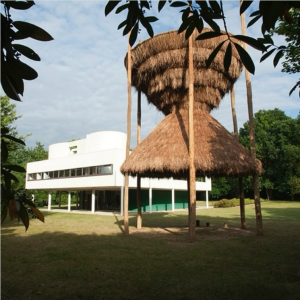
Cohabiter / Ch’ixi is a site-specific intervention by the Mexican artist Santiago Borja, conceived for memoria on the occasion of the launch of his book Rather Like a Shadow. Grounded in the principle of the coexistence of differences, the intervention draws on the Aymara concept of ch’ixi, which Borja mobilises to bring Indigenous heritages, material traditions and Western modernity into relation weaving connections between forms of knowledge, spaces and narratives without erasing their constitutive tensions that shape them.
For over twenty years, Santiago Borja has worked as both artist-architect and anthropologist. His research-based practice draws on skills and forms of know-how specific to certain regions of Mexico, weaving in particular, juxtaposing them with modernist thought and theory.
Image © Santiago Borja · Sitio · Villa Savoye · Passy, France, 2011
